About The Southeastern Massachusetts Pine Barrens Community Initiative (PBCI)
Page Updated 9/22/2012
To involve the regional community in preventing the further fragmentation and degradation of the Southeastern Massachusetts Regional Pine Barrens.
Southeastern Massachusetts' Pine Barrens at Risk
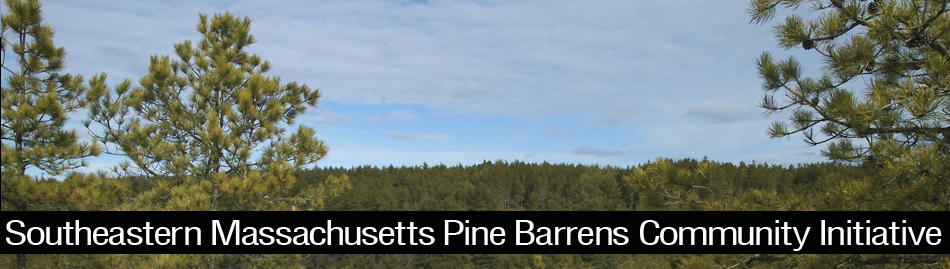
Myles Standish State Forest (MSSF) in southeastern Massachusetts lies at the heart of the second largest unbroken tract of globally rare pitch-pine barrens habitat remaining in the world. Spanning over 12,000 acres, MSSF is the second largest publicly held land in the Commonwealth. Yet, with Plymouth County being the fastest population-growing area in the state, development and degradation through careless use are threatening the sustainability of the region’s pine barrens. To reverse this trend, we need your help!
The Friends of MSSF, Inc. (FMSSF) began in 2007 with the dual purpose of promoting sustainable recreation and conservation of the Forest's natural environment. It didn't take us long to figure out that preserving the forest requires preservation of the entire southeastern Massachusetts pine barrens!
The FMSSF Board designated the Pine Barrens Community Initiative (PBCI) Committee to focus on promoting the region’s pine barrens as an endangered ecosystem that all residents can help preserve and protect from further fragmentation and general degradation resulting from destruction and removal of the native plant population. The PBCI has received strong support from the Massachusetts Department of Conservation and Recreation (DCR), local businesses and conservation groups. Now we need you to become involved.
Become a PBCI Native Plant Propagator
How? If you live in Kingston, Plymouth, Carver, Wareham or Cape Cod and the Islands you can help preserve the region's pine barrens by:
- Growing plants native to the Southeastern Massachusetts Regional Pine Barrens
- Collecting seeds from your garden and share them with your neighbors
- Letting everyone know that you are part of a growing initiative to preserve the health and beauty of the unique southeastern Massachusetts pine barrens in which you live.
Native plants for your "pine barrens" garden
Where can I find native plants?
The FMSSF PCI Committee has partnered with Morrison's Home and Garden, Inc. to make locally propagated native plants conveniently available to the public at a low cost. (Really low cost when you consider the work involved!)
Morrison's Home and Garden
90 Long Pond Road
Plymouth, MA 02360
(508) 746-0970Our plants are propagated by volunteers dedicated to the preservation of the region's pine barrens. The cost of the planting materials is covered by the FMSSF, a 501 (c)(3) charitable organization, through the donations of FMSSF members. Please consider joining the FMSSF or donating to help the PBCI.
To join please visit the FMSSF Membership Page.
History of the Pine Barrens Community Initiative
The Pine Barrens Community Initiative (PBCI) is a focused effort of the Friends of Myles Standish State Forest (FMSSF) and our partners to preserve the pine barrens region of southeastern Massachusetts. The FMSSF was organized by local volunteers in May 2007 to foster sustainable recreation and help preserve the fragile ecosystem of the Myles Standish State Forest. We soon realized that the forest does not end at the boundary line. To preserve the forest, we need to preserve the entire pine barrens region!
With the help of Robb Johnson, Southeast Massachusetts Program Director for The Nature Conservancy and Paul Gregory, DCR Assistant Management Forester, we have developed a three-fold program to:
- Collect data on indigenous plants for propagation and climate change studies, and develop source plants for propagation;
- Provide property owners, businesses, and agencies with native plants of local origin for restoration projects and native landscaping, and encourage community support of the local pine barrens ecology;
- Produce educational materials and programs on native and invasive plants, wildlife, fire safety, water quality, and the effects of climate change specific to the pine barrens.
In June 2010, the Friends of MSSF received a $5,000 grant from the A.D. Makepeace Neighborhood Fund to help expand and develop the PBCI program. We budget the project as funding allows, using the grant funds, support from DCR, donations to the Friends of Myles Standish State Forest, Inc. and in-kind contributions to carry out the initiative.
The PBCI includes: producing educational materials and programs to promote the preservation of SE MA pine barrens; creating a database of indigenous plants; developing indigenous plant sources for restoration projects and for home and business landscaping, supporting native birds and wildlife, invasive plant removal and collecting data for a climate change database.
Education
Too few people in southeastern MA understand the rare and endangered nature of the pine barrens ecosystem in which they live. Education and promotion is key to protecting the pine barrens and fostering sustainable living within the region.
- Produce educational materials/programs on fire safety, water quality, native and invasive plants, wildlife and the effects of climate change specific to pine barrens.
- Create map of regional pine barrens variations and quality.
- Develop one-page fact sheet on pine barrens ecology for distribution to forest visitors and for mailing.
- Create and print booklet on sustainable living within pine barrens ecosystem.
- Compile and distribute “Welcome to the Pine Barrens” packet to property development companies, realtors, and welcome groups.
- Continue outreach on the importance of maintaining a healthy pine barrens ecosystem through media, photo contest, guided hikes, tours, and educational forums and public events.
- Develop pine barrens resource web site, including a service for nature photo identification and questions.
Status:
- Collecting materials for educational and promotional component. Committee formed to interview artists for diagrammatic illustrations. Produced 2 community TV programs based on forums, The Wonders of the MSSF Pine Barrens (with TNC) and Global Climate Change (with Plymouth Area League of Women Voters). 4th Annual Friends of MSSF photo contest underway. Producing e-newsletters, hosting web site (www.friendsmssf.com
- Offering informational hiking/birding activities (http://www.meetup.com/Friends-of-Myles-Standish-SF-Hiking-Meetup-Group).
- Planning 6th annual community fishing event (September 29, 2012) designed to teach the next generation about the natural world in which they live..
- Regional Pine Barrens Conservation Map provided by DCR Forestry.
Native Plant Propagation/Distribution, Invasive Plant Eradication, Wildlife Support
Lack of sources for indigenous plants prevents property owners from installing and maintaining native landscaping. We encourage native plantings and provide native plants to the community to reduce fragmentation, support wildlife, and protect ground water.
- Formed partnership with Morrison's Home and Garden, Inc. to distribute plants propagated from seeds taken from plants native to the southeastern Massachusetts pine barrens region. To purchase FMSSF native plants, contact:
Morrison's Home and Garden
90 Long Pond Road
Plymouth, MA 02360
(508) 746-0970
- Establish an “Interpretive Native Plant Garden” at MSSF Headquarters. Set up greenhouse, as primary planting, propagation, recruitment and educational center. Greenhouse coming Fall 2012!
- Maintain East Entrance Native Plant Garden to help promote native plant landscapes.
- Encourage native planting on public and private property through the “Certified Pine Barrens Ecosystem” program (conversion of 30% of landscape receives special designation and recognition).
- Obtain seeds and cuttings of indigenous plants. Establish permanent source plantings for production.
- Create database to track propagation dates/techniques/results.
- Distribute plants at low or no cost to partners and project participants. Cooperate with local nurseries to develop plant stock for wider distribution.
- Form partnerships for regional invasive plant removal and native restoration projects.
- Native Bird Support Group monitoring 37 bird nesting boxes in the MSSF.
Status:
- Currently collecting and propagating indigenous plants with support from the Arnold Arboretum, Boston, MA.
- Demonstration native plant garden established at East Entrance.
- Propagation area established at Headquarters.
- PBCI Native Bird Support Group underway with support from DCR and MA Fish and Wildlife—monitoring 37 nesting boxes in MSSF, 23in the backyards of volunteers.
- Identifying invasive plants, working with DCR forestry on the control of spotted knapweed
- Created brochure highlighting the “Most Wanted” invasive plants: Invasive Plants Why They Must Go!.
Climate Change Mitigation and Data Collection
Climate change is already affecting the pine barrens of MSSF. We have identified three areas for climate change study participation.
- Study and protect frost pockets. MSSF contains 32 frost pockets, topographical depressions prone to unseasonable frost that support several rare species of plants and animals. Warming temperatures and destructive influences threaten the existence of frost pockets.
- Develop phenological observation program (i.e., observe and record dates when certain plants open leaves, go into flower, set fruit, produce ripe seed, and go dormant). May provide important scientific evidence of climate change.
- Organize volunteer participation in the Mass Audubon Breeding Bird Atlas 2 monitoring program in MSSF and region wide.
Status:
- Held two BBA2 meetings and training events. Bird monitoring in effect.
- Began pheno-data collection center on the web site www.salicicola.com, (contains a database of plant photos—334 species from MSSF— taken during different seasons since 2005/6; accumulated data to become a source of comparison over time. The checklist is published at salicicola.com under "Checklists". The list is updated a couple times a year.
- Hector Galbraith, PhD, Director of the Climate Change Initiative, Manomet Center for Conservation Sciences, has agreed to consult on the climate change aspects of the PBCI program.
Is It Native?
Need help identifying a plant? It's easy to find out what it is. See if it is already posted on the FMSSF Plant ID Page.
If your mystery plant is not there, you may submit a picture of the plant for expert identification here!
Would you like to help?
Please support the Friends of Myles Standish State Forest (FMSSF) and the Southeast Massachusetts Pine Barrens Community Initiative. Here's how:
1) Join FMSSF. We are an all volunteer tax exempt 501(c)(3) group. All donations benefit the forest and the Pine Barrens Community Initiative.
2) Participate in the Pine Barrens Home Yard and Garden Certification Program. Help preserve the southeastern MA pine barrens region by nurturing indigenous plants on your property. We will help you certify your home or business landscape as a beneficial pine barrens ecosystem. Contact us to find out more.
3) Volunteer to make a great forest even better. Join the FMSSF Hiking and Birding Meetup Group or sign up for the FMSSF e-newsletter for work party dates and information.
Explore a special feature of pine barrens—frost pockets
Alexey Zinovjev and Irina Kadis have uploaded a short illustrated note on their web site www.salicicola.com about frost pockets with pictures taken this summer. You will first see a cover photo of a wood lily taken on the margin of one of MSSF's frost pockets. To get to the frost pocket story, click on "Exploring Frost Pockets" under "Notes".
For those who enjoy large-screen monitors, Alexey has designed a more technologically advance version of the same show. Here is a direct link to Exploring Frost Pockets.
Please remember that frost pockets are one of the world's rare and most endangered ecosystems. If you visit, visit with care.